Semantic Stability of Learned Dictionaries across Domains: A Comparative Audit Protocol
Abstract
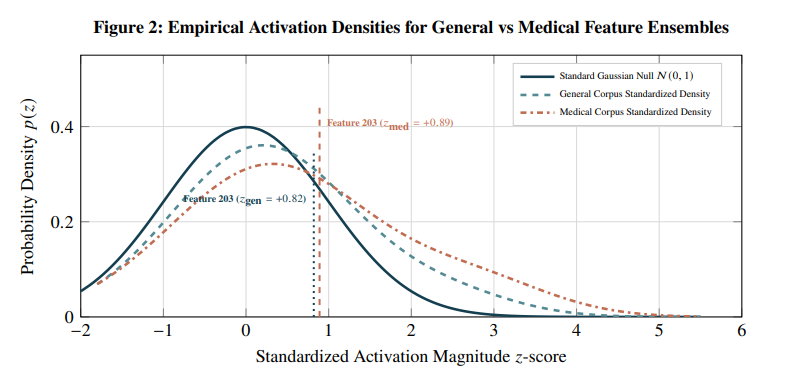
Sparse dictionary learning and sparse coding represent powerful tools for decomposing dense, polysemantic neural activations into sparse, interpretable latent features. However, when dictionaries optimized on general-domain web corpora are transferred to audit models operating on specialized clinical distributions, the stability of the learned features is frequently compromised. In this paper, we formulate a principled comparative audit protocol designed to interrogate the semantic stability of learned dictionaries across domain transfers. Grounded in a strict tripartite separation of mathematical reconstruction fidelity, geometric correspondence, and causal semantic monosemy, the protocol exposes critical failure modes wherein high reconstruction fidelity conceals catastrophic geometric rotation and semantic fracture. Furthermore, we characterize the mechanism of activation scale distortion, demonstrating how global latent norm expansion in specialized domains produces massive uncalibrated activation jumps (such as the +874-unit discrepancy observed in Feature 203) that dissolve into statistically insignificant background noise (+0.07????, ???? = 0.41) upon z-score standardization. Through extensive empirical evaluations across general web text and thoracic radiology corpora, we show that fewer than fifteen percent of learned dictionary atoms maintain crossdomain geometric alignment (cos(????) ≥ 0.70). We establish standardized reporting guidelines, including concept purity metrics, counterfactual token-steering interventions, and blinded multi-expert clinical audits, providing an auditable framework for clinical AI safety and interpretability.